
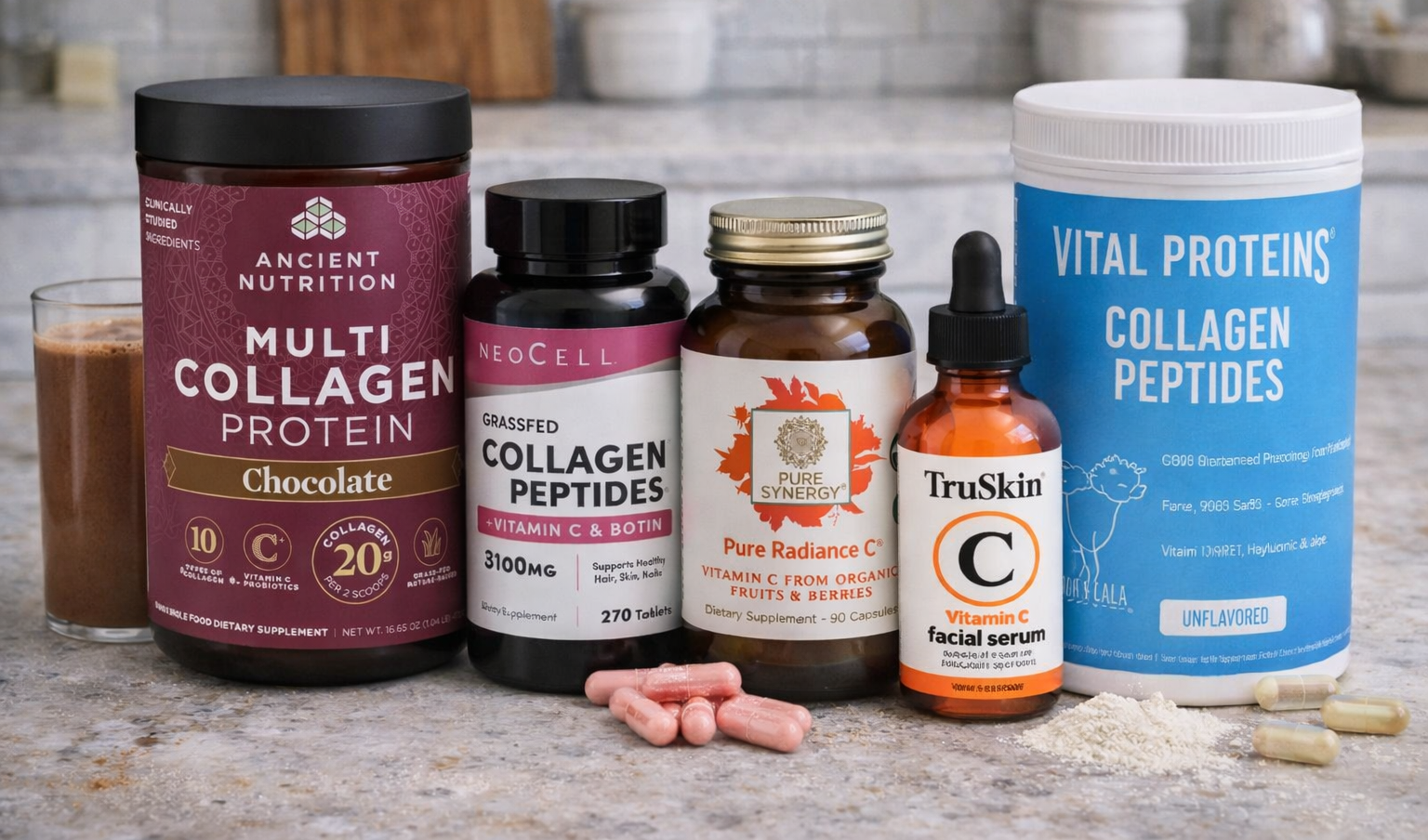
If you’ve wandered down the skincare supplement aisle recently, you’ve probably noticed that collagen products span an absolutely staggering price range. On one end, you’ve got basic collagen peptides for maybe fifteen dollars a month.
On the other, there are these beautifully packaged luxury options that can easily run you a hundred dollars or more for the same time period.
The marketing language around these premium products is really compelling. They talk about proprietary formulations, superior sources, and transformative results that supposedly justify the markup.
Yes, collagen supplements absolutely work for skin health.
The science backing this is actually quite solid, with many randomized controlled trials demonstrating real, measurable improvements.
But here’s the thing that might surprise you: the relationship between price and efficacy doesn’t come close to being as straightforward as the beauty industry would have you believe. Understanding what actually makes collagen work, and what’s just expensive window dressing, can save you a substantial amount of money while still delivering the skin benefits you’re after.
Understanding What Collagen Actually Does in Your Body
Before we get into the luxury versus standard debate, you need to really understand what happens when you take collagen supplements. Your body can’t actually absorb whole collagen molecules because they’re far too large.
Instead, hydrolyzed collagen (also called collagen peptides) has been broken down into smaller chains of amino acids that your digestive system can process.
Once absorbed, these peptides travel through your bloodstream and signal to your body’s fibroblasts (the cells responsible for producing new collagen) to ramp up production. The process is more sophisticated than simply eating collagen and having it magically appear in your skin. Complex biological signaling pathways trigger your own collagen synthesis.
The research backing this mechanism is pretty compelling. A comprehensive meta-analysis examining 26 randomized controlled trials with 1,721 participants found statistically significant improvements in both skin hydration and elasticity compared to placebo groups.
These weren’t marginal differences either.
Participants experienced measurable changes that could be objectively assessed using specialized equipment that measures skin properties.
What’s particularly interesting is that the improvements weren’t limited to one demographic. The benefits appeared across different age groups, skin types, and baseline skin conditions.
This suggests that collagen supplementation triggers a basic biological response as opposed to just addressing specific deficiencies in certain populations.
At-Home Women’s Health Test – Hormones & Wellness
Hormonal shifts can affect everything from energy and sleep to mood and weight. This at-home women’s health test helps you understand key hormone and wellness markers so you can make informed next steps with your healthcare provider.
- ✔ Screens hormones commonly linked to perimenopause and cycle changes
- ✔ CLIA-certified lab testing
- ✔ Physician-reviewed results with clear explanations
- ✔ Convenient finger-prick sample from home
FSA/HSA eligible • Test from home • Results you can discuss with your doctor
The Source Question: Marine vs Bovine vs Everything Else
Here’s where things get really interesting, and where luxury collagen brands typically stake their primary claim to superiority. Many premium products feature marine collagen sourced from wild-caught fish, and they’ll charge you significantly more for this supposed advantage.
The marketing often suggests that marine collagen is more bioavailable, more effective, or somehow more compatible with human skin than collagen from other sources.
The clinical evidence tells a different story. When researchers specifically analyzed whether collagen source affected outcomes, they found no statistically significant differences in elasticity improvements based on whether the collagen came from marine or bovine sources.
The statistical analysis showed a p-value of 0.21, which in research terms means there’s no meaningful difference worth noting.
Think about what this actually means for your purchasing decisions. If you’re paying double or triple the price specifically because a product contains marine collagen instead of bovine collagen, you’re essentially paying a premium for a distinction that doesn’t translate to better results.
The molecular structure of Type I collagen (the primary type found in skin) is remarkably similar across different animal sources once it’s been hydrolyzed into peptides.
Now, there are some legitimate reasons someone might prefer marine collagen. If you follow a pescatarian diet or have religious restrictions around beef products, marine collagen makes perfect sense.
Some people report that marine collagen dissolves more easily in liquids or has less taste.
These are valid practical considerations, but they’re different from claiming superior efficacy.
Porcine collagen (from pigs) represents another option that’s gaining traction, though it’s less common in the luxury segment. Chicken collagen, which contains more Type II collagen, is typically marketed more for joint health than skin benefits.
The key takeaway is that source matters far less than the supplement industry wants you to believe.
Dosage and Duration: The Real Determinants of Success
If source doesn’t significantly impact results, what actually does? The research points clearly to two factors: how much you take and how long you stick with it.
Studies demonstrating meaningful skin improvements typically used doses ranging from one to twelve grams daily, with most clustering around the five to ten gram range. When I examined the formulations of luxury collagen products like GNC’s Premier Collagen line, I found they contain between 10,000 and 13,000 milligrams per serving, which falls right in the middle of this effective range.
But, so do many standard collagen supplements that cost a fraction of the price.
The dosage parity across price tiers is actually quite remarkable. Whether you’re buying a fifteen-dollar tub of basic collagen peptides or a hundred-dollar box of luxury collagen shots, you’re likely getting roughly the same amount of actual collagen per serving.
The luxury products aren’t secretly packing in more collagen to justify their prices.
They’re working with the same dosage ranges that research has validated.
Duration matters even more than dosage. The clinical trials consistently show that collagen supplementation needs at least eight weeks before you’ll see meaningful results.
The improvements become increasingly favorable at twelve weeks and beyond.
This differs completely from taking a vitamin where you might feel an energy boost within days. Collagen supplementation is fundamentally about triggering a slow, sustained improvement in your skin’s structural integrity.
What this means practically is that any collagen supplement (luxury or standard) needs a long-term commitment. You can’t try it for two weeks, decide it’s not working, and move on.
The biological processes involved simply don’t operate on that timeline.
Your fibroblasts need consistent signaling over weeks and months to produce noticeable changes in skin quality.
Where Luxury Products Actually Differentiate Themselves
So if luxury collagen doesn’t contain better sources or higher doses, what exactly are you paying for? The answer lies primarily in three areas: complementary ingredients, delivery format, and branding.
Many premium collagen formulations include additional compounds designed to support skin health beyond just the collagen peptides. GNC’s Premier Collagen, for example, incorporates vitamin C along with other beauty-supporting nutrients.
This addition represents more than just marketing fluff.
There’s actually solid research showing that vitamin C combined with collagen yields superior elasticity improvements compared to collagen alone.
Vitamin C plays a critical role in collagen synthesis at the cellular level as an essential cofactor for the enzymes that stabilize collagen molecules, making it genuinely complementary to collagen supplementation. Including it in the formulation makes biochemical sense, though you could also achieve the same effect by taking basic collagen peptides alongside a vitamin C supplement for considerably less money.
Other ingredients you might find in luxury formulations include hyaluronic acid (which helps skin keep moisture), biotin (which supports nail and hair health), antioxidants like resveratrol or astaxanthin, and various plant extracts with anti-inflammatory properties. Some of these additions have their own research support, while others are included more for marketing appeal than demonstrated efficacy.
The ready-to-drink shot format represents another key differentiator for luxury products. Instead of scooping powder into your morning coffee, you’re grabbing a pre-measured, pre-mixed shot that’s ready to consume.
The convenience factor is genuinely appealing, especially for people with busy schedules or who travel often.
But that convenience comes at a substantial cost premium when you calculate it on a per-dose basis.
Then there’s the branding element. Luxury collagen products invest heavily in sophisticated packaging, celebrity endorsements, influencer marketing, and the creation of a premium brand identity.
These costs get passed directly to you.
You’re paying for the experience of using a product that feels exclusive and aspirational, which has psychological value for some people but doesn’t change the biochemical effectiveness.
Evaluating the Cost-Benefit Reality
Let’s get really practical about the economics here. A container of standard hydrolyzed collagen peptides from a reputable brand might cost around thirty dollars and provide a month’s supply at an effective dose.
A month’s supply of luxury collagen shots could easily run you eighty to a hundred and twenty dollars.
Over the course of a year (which is really the least timeframe you should think about for collagen supplementation), that difference becomes pretty staggering. You’re looking at potentially spending an extra six hundred to over a thousand dollars for the luxury option.
The question you need to honestly ask yourself is whether the complementary ingredients and convenience format genuinely justify that premium.
For some people, the answer might genuinely be yes. If you absolutely won’t remember to take a powder supplement but you’ll consistently consume a ready-to-drink shot, then the higher price might be worth it because consistency matters more than cost optimization.
If the additional ingredients meaningfully enhance your results or address other health concerns you have, that could tip the calculation in favor of premium products.
But for many people, the honest assessment would be that standard collagen peptides deliver essentially equivalent core benefits at a fraction of the price. You can add your own vitamin C.
You can develop a routine around mixing powder into beverages.
You can achieve the same basic outcomes without the luxury markup.
I’ve seen people spend hundreds of dollars monthly on luxury collagen while skipping sunscreen or drinking minimal water, which completely undermines their goals. The money you save by choosing standard collagen could go toward other skin-supporting interventions that might actually deliver more bang for your buck, like a quality retinol product, professional facials, or laser treatments.
Real-World Results and Timeline Expectations
One of the challenges with collagen supplementation is setting realistic expectations about what you’ll actually experience and when. The clinical trials show statistically significant improvements, but what does that translate to in terms of your daily lived experience?
Some people report noticing changes relatively quickly. There are anecdotal accounts of improved skin texture within a week and stronger nails within three weeks.
These early observations might reflect genuine biological changes, or they might represent heightened awareness of your skin and nails because you’ve started paying more attention to them.
In the early stages, separating placebo effects from real effects is genuinely hard.
The more substantial, objectively measurable improvements take longer. Around the eight to twelve week mark, you might notice that your skin holds moisture better, fine lines appear less pronounced, and your overall skin texture feels firmer and more resilient.
These changes typically develop gradually as opposed to appearing suddenly, which makes them easy to miss if you’re not specifically tracking them.
Taking progress photos can be remarkably helpful. Snap a bare-faced photo in consistent lighting before you start supplementation, then take comparable photos every four weeks.
The changes that are imperceptible day-to-day often become quite obvious when you compare photos taken months apart.
Personal results also vary considerably based on factors like your baseline collagen levels, age, overall diet quality, sun exposure history, and genetics. A twenty-five-year-old with minimal sun damage will have a different experience than a fifty-five-year-old who spent decades tanning.
This natural variation means that your personal timeline might differ from published research averages.
Making Collagen Supplementation Actually Work
Success with collagen supplementation needs more than just buying a product and taking it sporadically. Here’s how to actually maximize your results, whether you choose luxury or standard options.
First, commit to genuine consistency. Missing a few days here and there probably won’t derail your progress entirely, but you need to be taking your collagen most days for the biological signaling to work properly.
Set up whatever systems help you remember, whether that’s keeping the container next to your coffee maker, setting a phone reminder, or incorporating it into an existing morning routine.
Second, pay attention to timing and combination. While there’s no magic window when collagen works better, taking it with vitamin C enhances absorption and utilization.
If you’re using a basic collagen powder that doesn’t include vitamin C, consider taking it with orange juice, adding it to a smoothie with berries, or just taking a vitamin C supplement alongside it.
Third, support your collagen supplementation with broader lifestyle factors that affect skin health. No amount of collagen will overcome the damaging effects of chronic sun exposure without sunscreen, severe dehydration, or a diet completely devoid of skin-supporting nutrients.
Think of collagen as one important element in a comprehensive approach as opposed to a standalone solution.
Fourth, give it enough time before evaluating results. The eight-week least is really non-negotiable.
Ideally, you’d commit to twelve weeks before making any firm judgments about whether it’s working for you.
This needs some patience in an era where we’ve become accustomed to instant results, but the biology simply works on a slower timeline.
Common Mistakes That Undermine Results
Even with good intentions, people often make mistakes that limit their results from collagen supplementation. Understanding these pitfalls, problems, issues, problems, issues, problems, issues helps you avoid them.
One common error is starting with an insufficient dose. Some people assume that taking a tiny amount of collagen is better than nothing, but the research suggests there’s a least effective dose.
If you’re only getting two or three grams daily when studies show benefits at five to ten grams, you’re probably not triggering adequate biological responses.
Check the actual collagen content per serving and confirm you’re in the effective range.
Another mistake is inconsistency masked as “taking breaks.” Some people adopt a pattern of taking collagen for a few weeks, stopping for a week or two, then restarting. The biological processes involved need sustained signaling.
While you don’t necessarily need to take it literally every single day forever, long gaps undermine the added effects you’re trying to build.
Judging results too quickly represents another frequent problem. When people don’t see dramatic changes within two or three weeks, they often conclude that collagen doesn’t work for them and abandon it just before the timeframe when results typically become noticeable.
This premature evaluation wastes both money and opportunity.
Some people also make the mistake of buying collagen based purely on price, either choosing the absolute cheapest option without verifying quality, or assuming the most expensive must be the best. Neither approach serves you well.
Quality matters in terms of the hydrolyzation process and purity, but extreme price premiums often reflect marketing as opposed to meaningful quality differences.
People Also Asked
Does collagen really help with wrinkles?
Yes, clinical studies show that taking collagen supplements can reduce the appearance of wrinkles and fine lines. The improvements typically become noticeable after eight to twelve weeks of consistent use at doses of five to ten grams daily.
The collagen peptides signal your body to increase its own collagen production, which helps improve skin elasticity and firmness.
What is the best type of collagen to take for skin?
Type I collagen is the primary type found in skin and makes up the majority of most collagen supplements. Both marine and bovine sources contain Type I collagen, and research shows no significant difference in effectiveness between the two sources.
The dose and consistency of use matter much more than the source.
How much collagen should I take daily for skin benefits?
Most clinical trials showing skin improvements used doses between five and ten grams of collagen peptides daily. Some studies have used as little as one gram or as much as twelve grams, but the five to ten gram range appears most consistently effective for skin hydration and elasticity improvements.
Can I take collagen and vitamin C together?
Yes, you should take collagen and vitamin C together. Vitamin C is an essential cofactor for collagen synthesis in your body, and research shows that combining collagen supplementation with vitamin C produces better results than collagen alone.
Many premium collagen products include vitamin C for this reason.
How long does it take for collagen supplements to work?
You’ll need at least eight weeks of consistent daily use before seeing noticeable improvements in skin quality. Most clinical trials show that benefits continue to increase through twelve weeks and beyond.
Taking progress photos helps you track gradual changes that might not be obvious day-to-day.
Is hydrolyzed collagen better than regular collagen?
Hydrolyzed collagen (also called collagen peptides) is broken down into smaller amino acid chains that your digestive system can actually absorb. Regular, non-hydrolyzed collagen molecules are too large for your body to use effectively.
All quality collagen supplements use hydrolyzed collagen.
Does marine collagen work better than bovine collagen?
No, research shows no statistically significant difference in skin benefits between marine and bovine collagen sources. Both contain primarily Type I collagen, and once hydrolyzed into peptides, they function similarly in your body.
Choose based on dietary preferences as opposed to expecting different results.
Should I take collagen in the morning or at night?
There’s no strong evidence that timing matters significantly for collagen absorption. The most important factor is taking it consistently.
Choose whatever time fits best into your routine, whether that’s mixing it into your morning coffee or taking it before bed. Some people prefer taking it with vitamin C for enhanced absorption.
Key Takeaways
Collagen supplementation delivers genuine, clinically demonstrated benefits for skin hydration and elasticity, with robust research supporting its efficacy when used consistently over at least eight to twelve weeks at doses of five to ten grams daily.
The source of collagen (whether marine, bovine, or other animal sources) makes no statistically significant difference in outcomes, meaning premium charges for specific sources aren’t justified by superior results for skin health.
Dosage and duration matter far more than price point, with effective doses ranging from five to ten grams daily and meaningful results requiring months of consistent use as opposed to weeks of sporadic supplementation.
Luxury collagen products differentiate themselves primarily through complementary ingredients like vitamin C, convenient delivery formats like ready-to-drink shots, and premium branding as opposed to fundamentally different or superior collagen quality.
Standard hydrolyzed collagen peptides deliver essentially equivalent core benefits at substantially lower cost, making the luxury premium a choice about convenience and additional ingredients as opposed to a necessity for achieving results.
At-Home Women’s Health Test – Hormones & Wellness
Hormonal shifts can affect everything from energy and sleep to mood and weight. This at-home women’s health test helps you understand key hormone and wellness markers so you can make informed next steps with your healthcare provider.
- ✔ Screens hormones commonly linked to perimenopause and cycle changes
- ✔ CLIA-certified lab testing
- ✔ Physician-reviewed results with clear explanations
- ✔ Convenient finger-prick sample from home
FSA/HSA eligible • Test from home • Results you can discuss with your doctor
Find out our Recommended Collagen; visit: https://www.vitalwomenwellness.com/how-to-boost-collagen-naturally-after-40/
Disclaimer
The information contained in this post is for general information purposes only. The information is provided by Luxury Collagen Supplements: What You’re Actually Paying For and while we endeavor to keep the information up to date and correct, we make no representations or warranties of any kind, express or implied, about the completeness, accuracy, reliability, suitability or availability with respect to the website or the information, products, services, or related graphics contained on the post for any purpose.