Many beginners start arm training with an oversimplified approach ~ just picking up dumbbells and doing curls until fatigue sets in. While this seems straightforward, building stronger, well-developed arms requires more nuance than simply lifting heavier weights repeatedly.
Conflicting advice in fitness resources can add to the confusion. Questions like whether to train biceps or triceps first, whether to prioritize isolation or compound movements, or whether machines or free weights are better can leave beginners unsure how to progress.
Effective beginner arm training focuses on understanding how the muscles function, selecting foundational movements, and performing them with proper form and intention. The arms include multiple muscle groups ~ biceps, triceps, forearms, and even parts of the shoulders ~ and each benefits from either targeted isolation or compound exercises that engage multiple areas.
The following section outlines five essential arm exercises for beginners, explains why they are effective, and provides guidance on proper execution to ensure results without wasted effort or poor technique.
Everlywell 360 Full Body Test – 83 Biomarkers
Get a complete, high-level view of your health with one at-home test. This comprehensive panel measures 83 biomarkers across key health systems so you can spot trends, risks, and imbalances early.
- ✔ 83 biomarkers across metabolic, heart, thyroid, hormone & nutrient health
- ✔ CLIA-certified lab analysis
- ✔ Physician-reviewed results with clear explanations
- ✔ Simple at-home blood sample
FSA/HSA eligible • Comprehensive full-body insights
Understanding Arm Anatomy Before You Start
Before we jump into the exercises themselves, you really need to understand what you’re actually training. Your arms aren’t just “biceps and triceps”, that’s the oversimplified version that leads to imbalanced development and frustrating plateaus.
The biceps brachii is what most people picture when they think about arm muscles. This muscle sits on the front of your upper arm with two distinct heads: the long head and the short head.
But underneath your biceps sits the brachialis muscle, which most beginners completely ignore.
When you develop the brachialis through exercises like hammer curls and reverse curls, it actually pushes your biceps higher and makes them appear larger, even if your biceps themselves haven’t grown. This is one of those leverage advantages that advanced lifters use but beginners rarely learn.
On the back of your arm, you’ve got the triceps brachii, which has three heads: lateral, medial, and long. The triceps make up about two-thirds of your upper arm mass, which means if you’re only doing curls and ignoring tricep work, you’re literally neglecting the majority of your arm’s muscle volume.
That’s why balanced programming matters so much.
Your forearms contain dozens of smaller muscles responsible for wrist flexion, extension, and grip strength. These muscles get some indirect work during curls and rows, but they often need dedicated attention to develop properly.
The research on grip strength is actually fascinating, studies show strong correlations between grip strength and overall health markers, even longevity predictions.
So when you’re building forearm strength, you’re not just chasing aesthetics, you’re improving a legitimate health marker.
The Five Essential Exercises
1. Dumbbell Bicep Curls
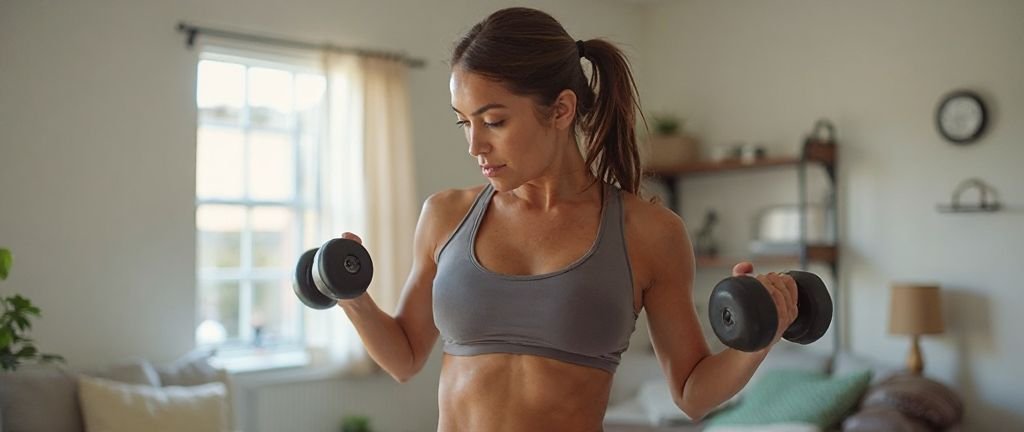
Yes, I know this seems obvious, but there’s a reason bicep curls have remained the foundation of arm training for decades. The movement is simple, effective, and when done properly, it builds not just your biceps and engages your forearms and even needs tricep stabilization.
Start by holding dumbbells with an underhand grip at shoulder width. Your arms should hang naturally at your sides with elbows close to your torso.
This elbow positioning is really crucial, when you let your elbows drift forward or backward during the movement, you’re stealing tension from the biceps and potentially creating shoulder compensation patterns that can lead to injury.
Curl the weights up toward chest height by flexing at the elbow while keeping your upper arm completely stationary. This is where most beginners mess up.
They start swinging their body, leaning backward, or letting their elbows move forward to generate momentum.
All of that is robbing your biceps of the tension they need to grow.
The lowering phase is where the magic really happens. Lower the weight with control over 2-3 seconds.
This eccentric phase creates greater mechanical tension and muscle damage than the lifting phase, which is why slowing down your reps works so effectively for beginners who don’t have access to progressively heavier weights.
If you’re stuck with the same dumbbells for a while, just slow down your reps and you’ll still make progress.
When you reach the top of the curl, rotate your pinky finger slightly outward. This supination creates extra bicep contraction that you wouldn’t get from a basic curl.
I use this technique on every single set now, and the difference in muscle activation is immediately noticeable.
2. Bent-Over Dumbbell Rows
Most beginners think rows are exclusively back exercises, and they’re missing out on one of the most effective bicep builders available. When you perform bent-over rows with proper technique, squeezing your shoulder blades together and keeping your elbows tucked close to your body, you create exceptional bicep engagement that pure isolation movements can’t match.
Hinge at your hips so your torso is roughly parallel to the floor. Keep your back flat, not rounded. This neutral spine position is non-negotiable for injury prevention.
Let the dumbbells hang straight down from your shoulders, then pull them up toward your ribcage by driving your elbows back behind your body.
Here’s the key detail that changes this from a back exercise into an arm exercise: at the top of the movement, really squeeze your shoulder blades together and think about pulling your elbows as far back as possible. This extends your range of motion and increases the muscle fiber recruitment throughout your biceps and the muscles of your upper back.
The movement also builds pulling strength that translates to other exercises and real-world activities. Unlike bicep curls where you’re only working in one plane of motion, rows develop your arms through a functional movement pattern that involves many joints and muscle groups working together.
This compound approach builds strength faster than isolation work alone, especially when you’re just starting out.
3. Overhead Tricep Extensions
Your triceps need just as much attention as your biceps, but they’re structured differently and respond better to exercises where your arm is overhead. The overhead position stretches the long head of the triceps, which runs from your shoulder blade down to your elbow, creating tension throughout the entire muscle.
Hold a single dumbbell with both hands overhead, arms fully extended. Your elbows should be pointing straight up toward the ceiling. Lower the weight behind your head by bending only at the elbows, your upper arms stay completely still, pointing upward.
This is that same principle we talked about with curls: when you keep the upper arm stationary and only move the forearm, you maximize isolation of the target muscle.
Lower until your elbows reach about 90 degrees, then press back up by extending through the elbows. Control is everything here.
If you’re dropping the weight quickly or using momentum to press it back up, you’re not creating the time under tension that drives muscle growth.
If overhead work bothers your shoulders, you can do this exercise with your back against an incline bench set to about 75 degrees. This provides support while still maintaining that overhead arm angle that targets the long head.
I actually prefer the bench-supported version now because it allows me to use slightly heavier weights without worrying about balance.
4. Push-Ups
I know what you’re thinking, push-ups are too basic, too easy, not “real” strength training. But this is one of those exercises where beginners consistently underestimate the value because they’re not doing them properly.
A proper push-up needs full-body tension. Before you even start moving, you should be actively squeezing your glutes, bracing your core, and packing your shoulder blades down and back.
Your body should form a straight line from your heels to your head.
This tension changes push-ups from a simple chest exercise into a comprehensive upper body and core movement.
Lower yourself by bending your elbows, keeping them at about a 45-degree angle relative to your torso, not flared out to the sides, not tucked completely tight. This angle optimally loads your triceps, chest, and shoulders while minimizing stress on your shoulder joints.
The bottom of the movement should bring your chest to within an inch or two of the floor. If you can’t maintain proper form through that full range of motion, start with elevated push-ups where your hands are on a bench or box.
As you get stronger, progressively lower the height until you’re working from the floor.
What makes push-ups particularly valuable for beginners is that they teach you how to create and maintain tension throughout your entire body during arm work. This skill transfers directly to other exercises and prevents the compensation patterns that lead to injury.
I spent my first month doing nothing but push-ups and rows, and that foundation made every other exercise easier to learn.
5. Dumbbell Shoulder Press
Your shoulders aren’t technically part of your arms, but they’re so interconnected with arm function that neglecting them creates imbalances and limits your overall upper body strength. The shoulder press builds your anterior and lateral deltoids, your triceps, your upper trapezius, and even engages your core for stabilization.
Start with dumbbells at shoulder height, palms facing forward, elbows bent at about 90 degrees and positioned slightly in front of your torso. Press the weights straight up overhead until your arms are fully extended, then lower back down with control.
The path of the dumbbells should be slightly forward, not straight up from your shoulders. This keeps the weight in line with your center of mass and reduces stress on your rotator cuff.
At the top, the dumbbells can touch or be very close together, don’t press them apart from each other.
For beginners, I actually recommend starting this exercise from a kneeling position. Half-kneeling shoulder presses force greater core engagement and prevent you from arching your lower back to compensate for shoulder mobility limitations.
Once you’ve mastered the movement pattern kneeling, you can progress to standing variations.
Building Your Beginner Arm Program
Now that you understand the five foundational exercises, you need to know how to structure them into an actual workout that creates progress without causing injury or burnout.
For the first 4-6 weeks of training, your goal focuses on mastering the movement patterns with moderate weights that you can control through a full range of motion. This patience pays off exponentially because proper form now prevents the bad habits that plague intermediate lifters later.
A simple structure that works really well is training arms twice per week with at least two days of rest between sessions. On the first day, prioritize the compound movements, bent-over rows and push-ups, when your nervous system is fresh and you can handle heavier loads.
Follow these with one isolation exercise for biceps and one for triceps.
Your second arm session each week can flip this priority, starting with isolation work and finishing with compound movements. This variation prevents your body from adapting too completely to one specific stimulus.
Rest periods matter more than most beginners realize. Between sets of your main exercises, rest for 60-90 seconds.
This allows your nervous system to recover enough to produce strong contractions on the next set while still maintaining some metabolic stress.
During finisher exercises or higher-rep work, you can shorten rest to 30-45 seconds to increase the metabolic demand.
Progressive overload drives all strength and muscle gains, but for beginners, it doesn’t have to mean adding weight every single workout. You can progress by adding one rep per set, by slowing down the eccentric phase, by reducing rest periods, or by improving your range of motion.
All of these create increased demand on your muscles, which forces adaptation.
I track every single workout in a simple notebook, exercise, weight, reps, and how it felt. This let’s me see patterns over time and ensures I’m actually progressing instead of just spinning my wheels doing the same thing week after week.
Common Mistakes That Stall Progress
The biggest mistake I see beginners make is using weights that are too heavy for their current strength level. When the weight is too heavy, you compensate by using momentum, arching your back, swinging your body, or cutting your range of motion short.
All of these compensations reduce the tension on the target muscle and increase your injury risk.
You should be able to control the weight through the entire movement, pause briefly at peak contraction, and lower it smoothly without dropping or jerking. If you can’t do this, the weight is too heavy regardless of what number is stamped on the dumbbell.
Another really common issue is neglecting forearm development. Most beginners assume their forearms will grow automatically from doing curls and rows, and while they’ll get some stimulation, it’s rarely enough for balanced development.
Adding even one exercise like wrist curls or farmer’s walks to each arm workout makes a substantial difference over time.
Training frequency is tricky for beginners. Some people think more is always better and try to train arms every single day.
Your muscles don’t grow during workouts, they grow during recovery.
Training arms 2-3 times per week with proper intensity produces better results than daily training with insufficient recovery time.
Advanced Variations for Continued Growth
Once you’ve built a solid foundation with these five exercises over 8-12 weeks, you’ll want to introduce variations to prevent adaptation and continue making progress.
Hammer curls, where you hold the dumbbells with a neutral grip (palms facing each other), shift emphasis to your brachialis and brachioradialis. These muscles contribute to overall arm thickness and that coveted peak when you flex.
Reverse curls use a pronated grip (palms down) to target your brachialis even more intensely while also hammering your forearm extensors. Remember what I mentioned earlier about how developing the brachialis actually pushes your biceps higher?
This is how you do it.
For triceps, close-grip push-ups, where your hands are positioned directly under your shoulders instead of wider, dramatically increase tricep engagement while still working your chest and core. This variation needs less equipment than overhead extensions and can be done anywhere.
Cable machines, if you have access to them, create constant tension throughout the entire range of motion. With dumbbell curls, tension is highest in the middle of the movement and decreases at the bottom when your arm is fully extended. With cable curls, the resistance stays constant from full extension to full flexion.
This mechanical advantage makes cables particularly valuable for finisher work at the end of your workout when you’re chasing that pump.
Warm-Up and Injury Prevention
Never skip your warm-up. I know it seems like wasted time when you’re excited to start lifting, but those 3-5 minutes of preparation dramatically reduce your injury risk and actually improve your performance during the workout itself.
Start with general movements that increase blood flow, jumping jacks, arm circles, or even just light kettlebell swings if you have a light weight available. Then move into specific warm-up sets of your first exercise using about 40-50% of your working weight.
Do 10-12 reps focusing entirely on form and range of motion, not on effort.
This neural preparation gets your nervous system ready to fire the fix movement patterns when you add heavier loads. It also increases synovial fluid in your joints, which lubricates them and reduces friction during loaded movements.
I learned this lesson the hard way after tweaking my elbow trying to jump straight into heavy curls without warming up properly. Two weeks of modified training could have been avoided with five minutes of preparation.
Nutrition and Recovery Considerations
Your arm training is only one piece of the puzzle. Those workouts create the stimulus for growth, but the actual muscle building happens during recovery when you’re eating and sleeping.
You need adequate protein, research consistently shows that 1.6-2.2 grams per kilogram of body weight supports muscle growth. For a 70kg person, that’s roughly 112-154 grams of protein daily.
Spread this across many meals instead of trying to consume it all at once.
You also need to be in a slight caloric surplus to maximize muscle growth. This doesn’t mean you have to eat massive amounts, but if you’re consistently in a caloric deficit, your body won’t have the resources to build new muscle tissue even if your training is perfect.
Sleep is non-negotiable. During deep sleep, your body releases growth hormone and conducts the majority of muscle protein synthesis.
Consistently getting 7-9 hours of quality sleep makes a measurable difference in your results.
I track my sleep with a simple app, and I can directly correlate my worst workouts with my worst sleep nights.
People Also Asked
What exercises build arm muscle fastest?
Compound exercises like bent-over rows and push-ups build arm muscle faster than isolation exercises because they allow you to use heavier loads and stimulate many muscle groups simultaneously. Bicep curls and tricep extensions work well as secondary exercises after your compound movements.
How many times a week should I train arms?
Training arms 2-3 times per week produces optimal results for most beginners. This frequency provides enough stimulus for growth while allowing adequate recovery time between sessions.
Daily arm training typically leads to overtraining and slower progress.
Do push-ups build arm muscle?
Push-ups build significant arm muscle, particularly in the triceps, when performed with proper form and full range of motion. The triceps perform the majority of the work during the pressing motion, while the biceps and forearms stabilize throughout the movement.
Should I do biceps or triceps first?
Start with whichever muscle group feels weaker or is lagging in development. Alternating which muscle group you train first between workout sessions ensures balanced development and prevents one area from consistently receiving priority when you’re freshest.
How long does it take to see arm muscle growth?
Most beginners notice visible arm muscle growth within 6-8 weeks of consistent training with proper nutrition and recovery. Strength gains typically appear within 2-3 weeks as your nervous system adapts, followed by visible muscle growth as the training continues.
Are dumbbells better than barbells for arms?
Dumbbells allow for greater range of motion and force each arm to work independently, which helps identify and fix strength imbalances. Barbells allow you to lift heavier total weight.
Both have value, but dumbbells work better for beginners learning proper movement patterns.
What weight should I start with for bicep curls?
Start with a weight that allows you to finish 10-12 controlled repetitions while maintaining perfect form throughout the entire range of motion. If you can do more than 15 reps easily, increase the weight.
If you can’t finish 8 reps with control, decrease the weight.
Why are my arms not getting bigger?
Arms fail to grow when training lacks progressive overload, nutrition is inadequate, recovery is not enough, or form is poor enough that the target muscles aren’t receiving proper tension. Track your workouts to ensure you’re actually progressing in weight, reps, or technique over time.
Key Takeaways
Understanding arm anatomy matters because your arms contain many distinct muscle groups that each need targeted attention for balanced development.
The five essential exercises for beginners cover all major arm muscles: dumbbell bicep curls, bent-over rows, overhead tricep extensions, push-ups, and shoulder presses.
Form and control determine your results more than the weight you’re lifting, so master the movement pattern with lighter loads before progressing to heavier weights.
Progressive overload means adding reps, slowing down tempo, reducing rest periods, or improving range of motion, not just adding weight every workout.
Training arms 2-3 times per week with adequate recovery produces better results than daily training without enough rest.
Forearm development needs dedicated attention because indirect stimulation from curls and rows rarely provides enough stimulus for balanced growth.
Proper warm-up and full-body tension during exercises prevent injury and improve performance throughout your workout.
Nutrition matters as much as training: adequate protein intake, slight caloric surplus, and 7-9 hours of sleep support muscle growth.
Cables and machines provide constant tension through the full range of motion, which complements the variable resistance of free weight training.
Patience and consistency over 8-12 weeks build the foundation for long-term progress and continued advancement to more complex training methods.
Everlywell 360 Full Body Test – 83 Biomarkers
Get a complete, high-level view of your health with one at-home test. This comprehensive panel measures 83 biomarkers across key health systems so you can spot trends, risks, and imbalances early.
- ✔ 83 biomarkers across metabolic, heart, thyroid, hormone & nutrient health
- ✔ CLIA-certified lab analysis
- ✔ Physician-reviewed results with clear explanations
- ✔ Simple at-home blood sample
FSA/HSA eligible • Comprehensive full-body insights
Disclaimer
The information contained in this post is for general information purposes only. The information is provided by Get Started: Top 5 Arm Exercises and while we endeavor to keep the information up to date and correct, we make no representations or warranties of any kind, express or implied, about the completeness, accuracy, reliability, suitability or availability with respect to the website or the information, products, services, or related graphics contained on the post for any purpose.