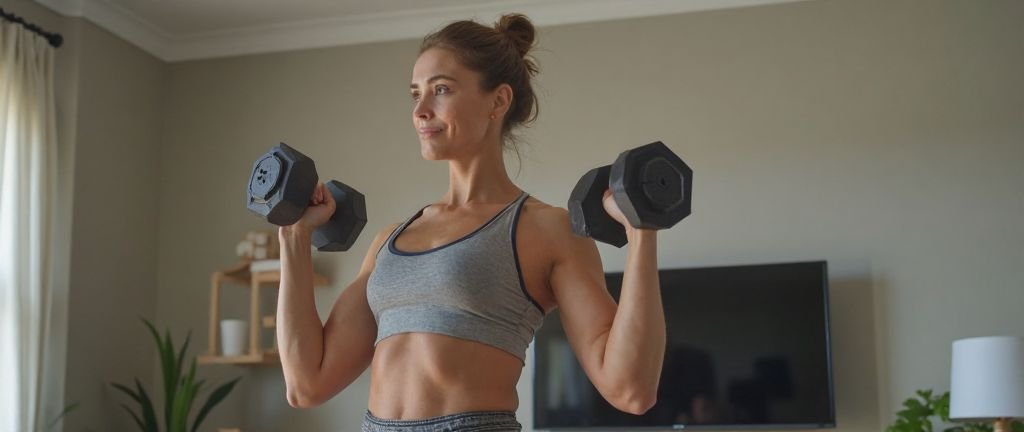
Dumbbells have quietly revolutionized how ordinary people build strength. In commercial gyms, they represent accessibility and versatility. In home workouts, they eliminate the need for expensive equipment and memberships.
In physical therapy clinics, they serve as tools for rehabilitation and functional movement restoration.
But for anyone starting a fitness program, they represent something more basic: a pathway to genuine physical transformation without complexity or pretense.
Personal trainers consistently recommend dumbbells to beginners for good reason. While machines can isolate muscles effectively, dumbbells force your body to stabilize weight through three-dimensional space, building not just strength but coordination and balance simultaneously.
Many people assume they need fancy equipment or gym memberships to get results. A decent set of adjustable dumbbells and some floor space can deliver transformative results if you understand proper programming and commit to consistent execution.
Before you grab those weights and start curling, here are some things to consider about building a genuinely effective dumbbell training practice.
Understanding the Biomechanics Behind Dumbbell Training
The magic of dumbbell work comes from something called proprioceptive demand. Unlike barbells or machines that guide the weight path, dumbbells need your nervous system to constantly watch and adjust position throughout every repetition.
This creates what researchers call neuromuscular adaptation, your brain literally rewires how it talks with your muscles.
When you press a dumbbell overhead, you engage far more than just your shoulders. Your rotator cuff muscles fire continuously to stabilize the joint.
Your core engages to prevent your spine from hyperextending.
Your grip muscles work to keep the weight secure. Even small stabilizer muscles in your feet and calves activate to maintain balance.
This full-body integration builds functional strength that transfers to real-world activities like lifting groceries, moving furniture, or playing with kids. The isolated muscle development you get from machines rarely translates the same way because those movements happen along fixed paths that don’t exist outside the gym.
The challenge for beginners comes from this complexity feeling overwhelming at first. Your arms might shake.
The weights might drift in unexpected directions.
You might feel like you’re working really hard but not actually targeting the muscles you intended. This awkward phase represents your nervous system learning new movement patterns, a necessary adaptation phase, not a sign of failure.
One concept that really changed how I approach dumbbell training is understanding the stretch-shortening cycle. When you lower a weight slowly and with control during the eccentric phase, you create tiny amounts of muscle damage that your body repairs by building stronger tissue.
Then when you drive the weight back up during the concentric phase, you teach your muscles to produce force efficiently.
The transition between these phases, that brief moment at the bottom of a squat or the end of a row, develops explosive power. Most people rush through this critical portion, missing out on significant strength gains.
Learning to control the weight through the entire range of motion, especially that transition point, separates effective training from wasted effort.
The eccentric phase deserves special attention because this is where most muscle damage and subsequent growth occurs. Your muscles can handle roughly 30-40% more load during eccentric contractions than concentric ones.
This means you can lower a heavier weight than you can lift, which is why controlled lowering builds strength so effectively.

Everlywell 360 Full Body Test – 83 Biomarkers
Get a complete, high-level view of your health with one at-home test. This comprehensive panel measures 83 biomarkers across key health systems so you can spot trends, risks, and imbalances early.
- ✔ 83 biomarkers across metabolic, heart, thyroid, hormone & nutrient health
- ✔ CLIA-certified lab analysis
- ✔ Physician-reviewed results with clear explanations
- ✔ Simple at-home blood sample
FSA/HSA eligible • Comprehensive full-body insights
Building Your Foundation with Strategic Exercise Selection
The biggest mistake I see beginners make is trying to do too much too soon. They find some massive workout list online with 15 different exercises and burn out after two sessions.
A smarter approach builds around five basic movement patterns: horizontal push, horizontal pull, vertical push, vertical pull, and squat or hinge variations.
For horizontal pushing, the dumbbell floor press becomes your foundation. Lying on your back with dumbbells in hand, you press upward while your shoulder blades stay stable against the floor.
This naturally limits range of motion, which protects your shoulders while you’re still learning proper mechanics.
As you get stronger, you can progress to bench presses or incline variations that increase the range and difficulty.
The floor press also teaches you to maintain tension throughout the lift. When the weight reaches the top position, beginners often relax their muscles, which wastes energy and reduces the training effect. Learning to keep your chest, shoulders, and triceps engaged from start to finish of every rep builds better motor control.
Horizontal pulling comes from bent-over rows and their variations. The key here is maintaining a neutral spine, not rounded like you’re slouching, not hyperextended like you’re trying to show off your chest.
When you hinge at the hips and draw the dumbbells toward your ribcage, you build the posterior chain muscles that counteract all the sitting and forward-leaning postures of modern life.
Most people row with too much arm and not enough back. The arms should function primarily as hooks connecting the weight to your back muscles.
Think about driving your elbows behind you rather than just pulling with your biceps.
This cue alone can transform an ineffective arm exercise into a powerful back builder.
Vertical pushing through overhead presses challenges your shoulder stability in a completely different plane. Start with dumbbells at shoulder height, palms facing each other.
As you press overhead, your shoulder blades should rotate upward naturally, don’t try to pin them down.
This upward rotation is healthy and necessary for full overhead range of motion. Trying to keep your shoulders “packed” throughout an overhead press actually restricts healthy movement and can lead to impingement issues over time.
Vertical pulling would typically need a pullup bar, but you can simulate it with pullover variations. Lying on your back with a single dumbbell held overhead in both hands, lower the weight behind your head with slightly bent arms, then pull it back over your chest.
This targets your lats from a different angle than rows and also stretches your chest muscles, which tend to get tight from all the sitting and computer work most people do.
For the lower body, goblet squats become your entry point. Holding a single dumbbell vertically against your chest, you squat down while the weight acts as a counterbalance, naturally encouraging proper positioning.
The front-loaded weight also teaches you to maintain an upright torso, which protects your lower back from excessive flexion.
Romanian deadlifts with dumbbells teach the hip hinge pattern, arguably the most important movement for long-term back health. The difference between a deadlift and a squat centers on hip hinge versus knee bend.
Deadlifts hinge at the hips with minimal knee bend, targeting your posterior chain. Think about pushing your hips backward like you’re trying to close a car door with your butt, not bending forward at the waist.
The hip hinge appears in countless daily activities, picking something off the floor, bending to tie your shoes, lifting a child. Learning to hinge properly with dumbbells transfers directly to these movements, reducing your injury risk significantly.
Most back injuries happen because people squat when they should hinge or round their spine when they should maintain neutral alignment.
Implementing Progressive Training Protocols
You could have perfect form and excellent exercise selection, but without a systematic approach to progression, you’ll plateau fast. The simplest progression model is linear periodization.
Start with a weight you can control for 12-15 repetitions with solid form.
Train with that weight 2-3 times per week, resting at least one day between sessions. When you can finish all prescribed sets and reps without form breakdown, increase the weight by roughly 5-10%.
This works brilliantly for the first 8-12 weeks of training. Eventually, linear progression slows down because you can’t just keep adding weight forever.
But during that initial phase, your nervous system is learning so rapidly that consistent progress happens almost automatically if you show up and do the work.
A sample three-day beginner program might look like this: Start with goblet squats for 3 sets of 10-12 reps, rest 90 seconds. Move to one-arm dumbbell rows for 3 sets of 10-12 reps per arm, rest 90 seconds.
Finish with dumbbell floor presses for 3 sets of 10-12 reps, rest 90 seconds.
That’s it, three exercises, nine total sets, done in about 30 minutes.
On day two, switch the emphasis. Begin with Romanian deadlifts for 3 sets of 10-12 reps.
Follow with overhead presses for 3 sets of 8-10 reps (fewer reps because overhead pressing is more technically demanding).
End with bicep curls for 3 sets of 12-15 reps. Day three can repeat your day one structure with slightly different variations, or you can take a more targeted approach based on how your body is responding.
The rest periods matter more than most people realize. When you’re lifting for strength with heavier weights and lower reps, rest 2-3 minutes between sets.
This allows your nervous system to recover fully.
When you’re working in higher rep ranges for muscle building, 60-90 seconds proves enough. For conditioning work, you might rest only 30-45 seconds to maintain elevated heart rate and metabolic stress.
Something I’ve found really valuable is tracking your workouts in a simple notebook or app. Write down the date, exercises, weights used, and how the sets felt. This removes guesswork and provides clear feedback about whether you’re progressing.
Looking back at where you started becomes incredibly motivating when you can see concrete improvements in the weights you’re handling.
Avoiding Common Training Mistakes
The temptation to lift heavier weight than you’re ready for is universal. I’ve done it, and I’ve watched countless others do it.
You see someone else curling 30-pounders and suddenly your 15s feel embarrassingly light.
But lifting weight you can’t control with proper form just teaches your body to compensate with poor movement patterns.
These compensations become ingrained quickly. After a few weeks of cheating your form to lift heavier weights, those faulty patterns feel normal.
Unlearning them takes significantly longer than learning correct form from the start.
The ego boost of using bigger numbers lasts about five seconds. The movement dysfunction can last years.
One specific compensation pattern shows up constantly in overhead presses. As the weight gets heavy, people hyperextend their lower back to help drive the dumbbells up.
This turns a shoulder exercise into a lower back injury waiting to happen.
The fix is to actively brace your core throughout the movement, imagine someone is about to punch you in the stomach and tense accordingly.
Another mistake is neglecting the eccentric portion of lifts. People get excited about lifting weight up, so they use momentum and acceleration on the concentric phase, then essentially drop the weight back to the starting position.
But the eccentric phase provides significant muscle damage and growth stimulus that you’re completely wasting with sloppy lowering.
Count to three on the way down for most exercises. This tempo, three seconds eccentric, one second concentric, builds incredible control and strength.
You’ll need to use lighter weights than you would with faster tempos, but the strength gains will be superior.
Slow eccentrics also reduce injury risk because you’re learning to control the weight through the entire range of motion.
Training through pain is a dangerous misconception. There’s a clear difference between muscle fatigue (the burning sensation in the last few reps of a set) and joint or connective tissue pain (sharp, localized discomfort that doesn’t go away).
Muscle fatigue is normal and productive.
Joint pain signals you should stop, assess your form, and potentially reduce weight or change the exercise.
I’ve seen people push through shoulder pain during overhead presses for weeks, thinking they just need to toughen up. What they actually need is to address the mobility restrictions or form issues causing the pain. Continuing to train through that type of discomfort doesn’t build character, it builds chronic injuries that eventually force you to stop training altogether.
Ignoring unilateral imbalances sets you up for problems down the road. Most people have a dominant side that’s stronger and more coordinated. When you only do bilateral exercises (both sides working together), the strong side compensates for the weak side.
Include single-arm and single-leg variations in your program to identify and address these imbalances before they become significant.
Adapting Your Approach to Different Contexts
Your training needs to flex based on your available time, energy, equipment, and goals. On days when you have 45 minutes and feel energized, you might work through a comprehensive full-body session with multiple exercises per movement pattern.
On days when you’re pressed for time or slightly fatigued, a focused 15-minute circuit of three exercises can still provide meaningful stimulus.
The time-density approach works brilliantly for busy schedules. Pick three exercises that work different movement patterns, maybe a goblet squat, a bent-over row, and an overhead press.
Perform each for 40 seconds with 20 seconds rest, cycling through all three.
Rest one minute, then repeat for 30 seconds work and 15 seconds rest. Rest another minute, then finish with 20 seconds work and 10 seconds rest.
You’ve created significant training volume in under 15 minutes.
This approach maintains training frequency even when life gets hectic. Consistency matters more than perfection.
Three 15-minute sessions per week will build more strength than one perfect 90-minute session because the frequent stimulus keeps your nervous system adapting.
For people with joint issues or mobility limitations, exercise modifications maintain training effectiveness without aggravation. Shoulder problems might make overhead pressing uncomfortable, but you can substitute with incline presses at a 45-degree angle.
Knee issues might limit deep squatting, but box squats where you sit back to a bench at a comfortable depth still build lower body strength.
Travel doesn’t have to derail your progress either. A single adjustable dumbbell set or even a pair of fixed-weight dumbbells in your hotel room enables full-body training.
Focus on higher-rep ranges and shorter rest periods when working with lighter-than-usual weights to maintain training intensity.
Bodyweight exercises can fill gaps when weights aren’t available.
Building Mastery Through Progressive Complexity
Once you’ve developed solid baseline strength and movement competence, usually after about 12 weeks of consistent training, you can layer in more sophisticated training techniques without overwhelming your recovery capacity.
Tempo manipulation becomes a powerful tool. Instead of standard-speed reps, you might use a 4-1-1 tempo: four seconds lowering the weight, one second pause at the bottom, one second lifting.
This dramatically increases time under tension and builds strength in stretched positions where muscles are most vulnerable.
Isometric holds inserted into your sets create a different type of challenge. During a goblet squat, pause for 5-10 seconds at the bottom position before standing.
This teaches your nervous system to maintain tension and produce force from mechanically disadvantaged positions.
These pauses also identify mobility restrictions you might be compensating for with momentum.
Unilateral work progresses from basic single-arm rows to more challenging variations like single-leg Romanian deadlifts. These exercises force your core to resist rotation while one limb works, building functional stability that translates to athletic performance and injury prevention.
The balance challenge alone provides significant training stimulus.
Complex training combines strength work with explosive movements. After a set of heavy goblet squats, immediately perform 8-10 jump squats with no weight.
The heavy load primes your nervous system, making the explosive movement feel lighter and training your body to produce force rapidly.
This post-activation potentiation effect can improve power output significantly.
People Also Asked
How heavy should dumbbells be for beginners?
Start with weights that allow you to finish 10-12 repetitions with perfect form while the last 2-3 reps feel challenging but controlled. For most beginners, this means 5-15 pounds for upper body exercises and 10-25 pounds for lower body movements. Women typically start on the lower end of these ranges, men on the higher end.
The specific weight matters less than choosing a load that challenges you without compromising form.
Can you build muscle with just dumbbells?
Yes, dumbbells provide enough resistance to build significant muscle mass. The key is progressive overload, consistently increasing the challenge through heavier weights, more reps, or advanced variations.
Bodybuilders used primarily dumbbells and barbells for decades before modern machines existed. Dumbbells actually offer advantages over machines for muscle building because they need stabilizer muscle activation and allow natural movement paths.
How many days per week should I train with dumbbells?
Three to four days per week allows optimal muscle growth while providing adequate recovery time. Beginners should start with three full-body sessions, resting at least one day between workouts.
More advanced lifters can train four to five days using split routines that work different muscle groups on different days, allowing some muscles to recover while training others.
What exercises can I do with one dumbbell?
Goblet squats, single-arm overhead presses, single-arm rows, Romanian deadlifts, Turkish get-ups, Russian twists, and pullovers all work effectively with a single dumbbell. Many traditional two-dumbbell exercises can be adapted to single-arm variations, which actually provide extra core training benefits as your torso resists rotation from the uneven load.
Do dumbbells burn belly fat?
Dumbbells help reduce overall body fat, including belly fat, through building muscle mass and increasing metabolic rate. However, spot reduction doesn’t exist, you cannot target fat loss in specific body areas through exercise alone.
Consistent strength training combined with suitable nutrition creates the caloric deficit needed for fat loss while preserving muscle mass.
How long should a dumbbell workout last?
Effective dumbbell workouts range from 15 to 45 minutes depending on your experience level and goals. Beginners can build strength with 20-30 minute sessions focused on basic compound movements.
More advanced lifters might need 45-60 minutes to finish higher-volume programs.
Quality matters more than duration, a focused 20-minute session beats a distracted hour-long workout.
Key Takeaways
Start with lighter weights than your ego wants and focus obsessively on movement quality for the first month of training. The neuromuscular adaptations you build now create the foundation for everything that follows.
Structure your training around basic movement patterns rather than chasing a huge variety of exercises. Master the basics before adding complexity.
Progressive overload is non-negotiable for continued adaptation. When a weight becomes manageable for your prescribed rep range with good form, increase the load by 5-10%.
Recovery between sessions matters as much as the training itself. Muscles grow during recovery periods when your body repairs and adapts to the stress you’ve imposed.
Unilateral exercises reveal and address imbalances before they become significant problems that limit your progress or increase injury risk.
Tempo manipulation and time under tension create training effects that straight rep counting misses entirely. How you perform a rep often matters more than how many reps you finish.
Document your training consistently to remove guesswork and provide clear data about whether your approach is working or needs adjustment.
Everlywell 360 Full Body Test – 83 Biomarkers
Get a complete, high-level view of your health with one at-home test. This comprehensive panel measures 83 biomarkers across key health systems so you can spot trends, risks, and imbalances early.
- ✔ 83 biomarkers across metabolic, heart, thyroid, hormone & nutrient health
- ✔ CLIA-certified lab analysis
- ✔ Physician-reviewed results with clear explanations
- ✔ Simple at-home blood sample
FSA/HSA eligible • Comprehensive full-body insights
Find out our Recommended Products for women’s fitness; visit: https://www.vitalwomenwellness.com/best-protein-powders-for-women-to-crush-their-new-year-fitness-goals/
Disclaimer
The information contained in this post is for general information purposes only. The information is provided by Kickstart Your Fitness Journey with Dumbbells and while we endeavor to keep the information up to date and correct, we make no representations or warranties of any kind, express or implied, about the completeness, accuracy, reliability, suitability or availability with respect to the website or the information, products, services, or related graphics contained on the post for any purpose.