
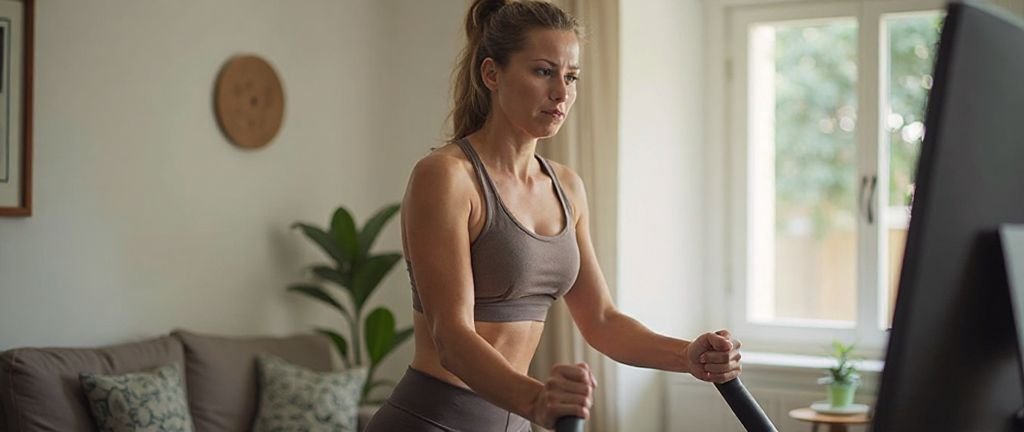
Arm training is often overlooked in many workout routines. While push-ups, pull-ups, and other compound exercises contribute to overall upper-body strength, they do not always provide sufficient stimulus for balanced arm development.
Observing focused, controlled exercises ~ such as barbell curls performed with strict form ~ highlights the difference between compound-only routines and targeted arm work. Proper isolation exercises allow muscles to contract fully and develop proportionally, improving both strength and aesthetics.
Recognizing the importance of dedicated arm training can significantly enhance upper-body results and prevent arms from being treated as an afterthought in a workout program.
Everlywell 360 Full Body Test – 83 Biomarkers
Get a complete, high-level view of your health with one at-home test. This comprehensive panel measures 83 biomarkers across key health systems so you can spot trends, risks, and imbalances early.
- ✔ 83 biomarkers across metabolic, heart, thyroid, hormone & nutrient health
- ✔ CLIA-certified lab analysis
- ✔ Physician-reviewed results with clear explanations
- ✔ Simple at-home blood sample
FSA/HSA eligible • Comprehensive full-body insights
Understanding Arm Anatomy Beyond the Basics
Most people walk into the gym thinking arms equal biceps. That was definitely my mindset early on.
But the reality is much more interesting and, honestly, much more important if you actually want to build impressive arm strength and size.
Your arms consist of three primary muscle groups that all need attention. The biceps brachii sits on the front of your upper arm and gets all the glory, but it only comprises about one-third of your total arm mass.
The triceps brachii, running along the back of your upper arm, makes up approximately two-thirds of your arm mass.
Then you have this entire forearm complex that includes the brachialis, brachioradialis, and all these flexor and extensor muscles that most people completely ignore.
The brachialis muscle sits right underneath your biceps and contributes significantly to arm thickness when you train it properly. Most people never directly target it, which is why their arms look flat from certain angles.
The brachioradialis runs along your forearm and gives you that really developed look when your sleeves are rolled up.
What really matters here is understanding that if you want bigger, stronger arms, you need to give serious attention to your triceps. I spent probably two years doing three bicep exercises for every one tricep exercise, wondering why my arms looked small despite all the work I was putting in. Once I flipped that ratio and started hammering triceps with the same intensity I gave biceps, everything changed within about six weeks.
Your triceps have three heads, the long head, lateral head, and medial head. Each responds to slightly different angles and exercises.
The long head crosses both the shoulder and elbow joints, which means overhead tricep exercises like skull crushers hit it differently than exercises like pushdowns.
The lateral head gives you that horseshoe shape when viewed from the side. The medial head sits deeper and provides stability throughout all pressing movements.
Understanding this anatomy helps you select exercises that actually target weak points instead of just randomly doing whatever feels good in the moment.
The Foundation: Compound Movements for Arm Development
Here is where most training programs get it backwards. Everyone wants to jump straight to isolation work, curling dumbbells in front of the mirror.
But compound movements build the foundation for serious arm strength in ways isolation exercises simply cannot match.
Close-grip bench press became one of my absolute favorite exercises once I understood its value. You set up like a regular bench press, but bring your hands in so they are roughly shoulder-width apart or slightly narrower.
This shifts the emphasis dramatically from your chest to your triceps while still engaging your shoulders and core for stability.
I typically perform these with four sets of six reps, really focusing on the eccentric portion where I lower the bar slowly to my chest. The weight moves in a straight line down to your lower chest, and your elbows stay closer to your body compared to a regular bench press.
This elbow position is what shifts the load onto your triceps.
You can handle serious weight on this movement because multiple muscle groups contribute. That heavy loading creates a different kind of stimulus than you get from isolation work.
Your nervous system learns to recruit more muscle fibers, and that carries over to everything else you do.
Pull-ups and chin-ups are non-negotiable if you want functional arm strength. Pull-ups with an overhand grip emphasize your lats and forearms, while chin-ups with an underhand grip shift more emphasis to your biceps.
I alternate between these variations weekly, and I have seen more bicep development from heavy chin-ups than from any curl variation I have tried. The added benefit is you are building serious grip strength simultaneously, which carries over to literally every other arm exercise you perform.
When you perform a chin-up, your biceps work through a massive range of motion while supporting your entire bodyweight. That creates a training stimulus that you simply cannot copy with light dumbbell curls.
Once you can perform ten to twelve clean chin-ups, start adding weight with a dip belt or weighted vest.
The farmers carry might look simple, but it builds tremendous forearm and grip strength. You grab heavy dumbbells or kettlebells, hold them at your sides, and walk for distance or time.
I typically walk for thirty to forty seconds per set, using weights that make the last ten seconds really challenging.
Your forearms burn intensely, your traps engage to stabilize the weight, and your core works overtime to keep you upright. This exercise has done more for my overall arm development than probably any isolation movement.
The beauty of farmers carries is they train your grip in a way that mimics real-world strength. You are a lot more influentual than squeezing something statically, you are holding heavy objects while moving, which requires constant micro-adjustments from all the small muscles in your hands and forearms.
Isolation Work That Actually Matters
Once you have built a solid foundation with compound movements, isolation exercises become incredibly valuable for targeting specific weaknesses and pushing past plateaus.
Barbell bicep curls stay a classic for good reason. You stand with feet shoulder-width apart, grab a barbell with an underhand grip, and curl it toward your chest while keeping your elbows locked at your sides.
The key here is eliminating momentum completely.
I see so many people swaying their entire body, turning a bicep curl into some kind of full-body swing movement. That defeats the entire purpose.
Lock your core, keep your back straight, and move only your forearms.
If you cannot finish the rep with perfect form, the weight is too heavy. Your elbows should stay pinned to your sides throughout the entire movement.
Think of them as hinges that do not move forward or backward.
Only the lower portion of your arm moves while everything else stays locked in position.
Hammer curls specifically target that brachialis muscle I mentioned earlier. Instead of having your palms face up like a traditional curl, you keep your palms facing each other throughout the movement, like you are hammering something.
This neutral grip shifts the emphasis and really builds arm thickness.
I perform these with three sets of ten reps, really focusing on squeezing at the top of each rep. The neutral grip also reduces stress on your wrists, which makes this variation easier on your joints compared to standard curls.
Over time, developing your brachialis pushes your biceps up and out, creating more overall arm size.
Skull crushers transformed my tricep development. You lie on a bench holding a barbell with arms extended straight up, then lower the bar toward your forehead by bending only at the elbows.
Your upper arms stay completely stationary throughout.
The stretch you get at the bottom position and the contraction at the top provide incredible stimulus for tricep growth. Just be really careful with these because the name is unfortunately accurate if you lose control of the weight.
I prefer using an EZ curl bar for skull crushers because the angled grip feels more natural on my wrists and elbows. You can also perform these with dumbbells, which allows each arm to work independently and helps identify strength imbalances.
Reverse curls often get skipped, but they are essential for complete forearm development. You perform them exactly like barbell curls except your palms face down instead of up.
This pronated grip shifts the emphasis to your brachioradialis and forearm extensors.
You will need to use significantly lighter weight than regular curls, maybe fifty to sixty percent of what you would normally curl. Do not let your ego convince you otherwise.
The first time I tried reverse curls with my normal curl weight, I could barely complete three reps.
Dropping to a more suitable weight allowed me to perform clean sets that actually built strength.
Progressive Overload Principles That Work
Nothing matters more for building arm strength than progressive overload. This principle sounds really simple but needs consistent discipline over months and years.
You must gradually increase the stress you place on your muscles over time, whether that means adding weight, increasing reps, decreasing rest periods, or improving your time under tension.
I track every single arm workout in a training journal. I write down the exercise, weight used, reps completed, and how the set felt.
This gives me concrete data to reference.
If I performed dumbbell curls with thirty-pound dumbbells for three sets of ten reps last week, I know I need to either increase to thirty-two pounds, add an extra rep or two, or decrease my rest period this week. Without tracking, you are just guessing, and guessing leads to stagnation.
The mistake I made early on was trying to increase weight every single workout. That works for maybe a few weeks when you are a complete beginner, but it becomes unsustainable really quickly.
Now I focus on adding one or two reps per set over two or three weeks, then increase the weight by the smallest increment possible and start the process again. This slower approach has produced far better results with much less joint pain and fewer injuries.
Most commercial gyms only have dumbbells that increase in five-pound increments. Going from thirty-pound dumbbells to thirty-five-pound dumbbells represents more than a fifteen percent jump in load.
That is too much for consistent progression.
I bought my own micro-loading plates, small magnetic plates that attach to dumbbells in one or two-pound increments. This allows much smoother progression.
Time Under Tension and Tempo Training
Time under tension completely changed how I think about arm training. Instead of just counting reps, you focus on how long your muscles stay under load during each set.
A set of ten reps performed quickly might only provide twenty seconds of time under tension, while the same ten reps performed with controlled tempo could provide forty-five to sixty seconds.
I started implementing specific tempos for different exercises. For bicep curls, I use a three-one-three tempo: three seconds lifting the weight, one second pause at the top, three seconds lowering.
That seven-second rep means ten reps provides seventy seconds of time under tension, which falls right in the optimal range for hypertrophy.
The eccentric phase, where you lower the weight, deserves special attention. Research consistently shows that the lowering portion of exercises causes more muscle damage and adaptation than the lifting portion.
I emphasize this by sometimes using four or even five seconds on the eccentric phase.
Your muscles can handle more load eccentrically than concentrically, so you can really push this component. You might even try eccentric-only training occasionally, where a training partner helps you lift the weight and you focus entirely on a slow, controlled lowering phase.
This creates extreme soreness initially but produces impressive strength gains.
Tempo training removes guesswork and forces you to maintain control throughout the entire range of motion. You cannot cheat or use momentum when you are counting seconds.
It also keeps your mind engaged with every single rep instead of just mindlessly moving weight around. The mental focus required to count tempo while fighting fatigue creates a stronger mind-muscle connection, which helps you recruit more muscle fibers.
Advanced Intensity Techniques
Drop sets push muscles to complete fatigue and beyond. You perform a set to failure, immediately reduce the weight by twenty to thirty percent, and continue for more reps.
You can do this multiple times in a single set, creating what some people call a triple drop set.
I typically use drop sets as a finisher for arm workouts. After completing my primary working sets of an exercise, I will load up for one final drop set.
For example, with dumbbell curls, I might start with forty-pound dumbbells and rep to failure around eight reps, immediately grab thirty-pound dumbbells and rep to failure again around six to eight reps, then grab twenty-pound dumbbells for a final ten to twelve reps.
Your arms feel completely engorged with blood after this, and the metabolic stress is intense. The pump you get from drop sets is honestly ridiculous.
Your arms temporarily swell up significantly as blood floods into the working muscles.
This metabolic stress triggers different growth pathways compared to heavy strength training.
Supersets pair two exercises back-to-back with minimal rest between them. Antagonistic supersets pair opposing muscle groups, like biceps and triceps.
I might perform a set of barbell curls immediately followed by a set of tricep pushdowns, rest for ninety seconds, then repeat.
This approach is incredibly time-efficient and keeps blood flowing through the entire arm region. The blood rushing back and forth between opposing muscle groups creates this sustained pump that lasts throughout your entire workout.
Agonist supersets pair exercises for the same muscle group. You might do hammer curls immediately followed by regular dumbbell curls, both targeting biceps from slightly different angles.
This creates enormous metabolic stress and really pushes the muscle past its normal fatigue threshold.
Grip Strength as the Foundation
Your grip strength decides how much weight you can effectively use for virtually every arm exercise. If your grip gives out before your biceps during heavy barbell curls, you are leaving gains on the table.
I learned this the hard way after months of feeling like my forearms limited every back and arm movement I attempted.
Wrist curls directly target forearm flexors. You sit on a bench, rest your forearms on your thighs with your wrists hanging off the edge, and curl a barbell or dumbbells using only wrist flexion.
These feel really awkward at first but build incredible forearm strength over time.
I perform both palms-up wrist curls for the flexors and palms-down wrist curls for the extensors. Most people only train the flexors, which creates imbalances that can lead to elbow problems.
Training both sides of your forearms maintains balance and prevents injury.
Dead hangs from a pull-up bar build serious grip endurance. Just grab the bar and hang for as long as possible.
When I started, I could barely hang for twenty seconds.
Now I can hang for well over a minute, and my grip strength during other exercises has improved dramatically.
Structuring Your Arm Training Program
Training frequency matters more than most people realize. The old bodybuilding approach of hitting arms once per week with massive volume works for some people, but most people get better results training muscles two to three times per week with moderate volume per session.
I structure my arm training with three sessions weekly. Monday focuses on biceps and forearms with exercises like barbell curls, hammer curls, and wrist curls.
Wednesday emphasizes triceps with movements like close-grip bench press, skull crushers, and overhead extensions.
Friday includes lighter, higher-rep work for both muscle groups to increase blood flow and aid recovery.
This frequency allows adequate recovery between sessions while providing multiple growth stimuli throughout the week. Each session includes twelve to sixteen total working sets for arms.
That might be three exercises with four sets each, or four exercises with three to four sets each.
More volume does not automatically mean better results. Quality matters far more than quantity.
I used to think doing twenty sets per muscle group would produce twice the results of ten sets.
All it produced was overtraining, joint pain, and frustration when my arms stopped growing.
Deload weeks every four to six weeks allow your joints, tendons, and nervous system to recover. During a deload, I reduce both volume and intensity by about forty to fifty percent.
Instead of four sets of eight reps with heavy weight, I might do two sets of eight reps with moderate weight.
This planned recovery prevents injury and often leads to breaking through plateaus in the following weeks. Your body adapts during rest, not during training.
People Also Asked
How long does it take to build arm strength?
You can expect noticeable improvements in arm strength within four to six weeks of consistent training. Beginners often see faster progress, sometimes adding significant weight to their exercises within the first month.
More experienced lifters might take several months to see measurable strength increases.
Building serious arm mass takes longer, typically three to six months of dedicated training before you notice substantial size changes.
What is the fastest way to increase arm strength?
The fastest way to increase arm strength combines heavy compound movements like close-grip bench press and weighted chin-ups with consistent progressive overload. Focus on adding weight or reps every week, train arms two to three times weekly, and prioritize recovery through adequate sleep and protein intake.
Compound movements allow you to handle heavier loads than isolation exercises, which stimulates greater strength adaptations.
Can you build arm strength without weights?
Yes, you can build significant arm strength using bodyweight exercises like push-ups, dips, chin-ups, and pull-ups. These movements become progressively harder as you add variations like one-arm push-ups, archer push-ups, or weighted vests.
Bodyweight training works especially well for beginners and intermediate lifters, though advanced athletes eventually need additional resistance for continued progress.
Why are my arms not getting stronger?
Your arms might not be getting stronger because you are not applying progressive overload, not training them frequently enough, or not recovering adequately between sessions. Other common issues include poor exercise form that shifts tension away from target muscles, not enough protein intake below 0.7 grams per pound of bodyweight, or training arms when already fatigued from other exercises.
Track your workouts to confirm you are actually increasing training stress over time.
How many times a week should I train arms for strength?
Training arms two to three times per week produces better strength results than once-weekly training for most people. This frequency provides multiple growth stimuli while allowing adequate recovery between sessions.
Beginners might benefit from three sessions weekly with lower volume per session, while advanced lifters might need only two sessions but with higher intensity and volume.
Do triceps make arms look bigger than biceps?
Yes, triceps contribute more to overall arm size because they comprise roughly two-thirds of upper arm mass. Developing your triceps creates thickness when viewing arms from the side and adds significant circumference when measuring around the largest part of your upper arm.
Many people neglect triceps in favor of bicep training, which limits their total arm development.
What foods help build arm muscle?
High-protein foods help build arm muscle by providing amino acids necessary for muscle repair and growth. Effective options include chicken breast, eggs, Greek yogurt, lean beef, fish like salmon, and plant-based sources like lentils and quinoa.
Aim for roughly one gram of protein per pound of bodyweight daily, distributed across multiple meals.
Carbohydrates like rice, oats, and potatoes provide energy for intense training sessions.
Key Takeaways
Building genuine arm strength requires understanding that triceps comprise two-thirds of arm mass and deserve equal or greater attention than biceps. Compound movements like close-grip bench press, chin-ups, and farmers carries build the foundation for arm development more effectively than isolation exercises alone.
Progressive overload stays non-negotiable, requiring you to gradually increase the stress placed on muscles through added weight, reps, or intensity techniques.
Time under tension and controlled tempo training, especially emphasizing the eccentric phase, produce superior hypertrophy compared to simply moving heavy weight quickly. Grip strength limits your potential on virtually every arm exercise, making forearm training essential as opposed to optional.
Training frequency of two to three times weekly with moderate volume per session outperforms traditional once-weekly high-volume approaches for most people.
Recovery, including adequate protein intake, quality sleep, and planned deload weeks, decides when and how much your arms actually grow.
Everlywell 360 Full Body Test – 83 Biomarkers
Get a complete, high-level view of your health with one at-home test. This comprehensive panel measures 83 biomarkers across key health systems so you can spot trends, risks, and imbalances early.
- ✔ 83 biomarkers across metabolic, heart, thyroid, hormone & nutrient health
- ✔ CLIA-certified lab analysis
- ✔ Physician-reviewed results with clear explanations
- ✔ Simple at-home blood sample
FSA/HSA eligible • Comprehensive full-body insights
Find out our Recommended Protein Powders for Women to Crush Their Fitness Goals; visit: https://www.vitalwomenwellness.com/best-protein-powders-for-women-to-crush-their-new-year-fitness-goals/
Disclaimer
The information contained in this post is for general information purposes only. The information is provided by Building Arm Strength: A Full Guide and while we endeavor to keep the information up to date and correct, we make no representations or warranties of any kind, express or implied, about the completeness, accuracy, reliability, suitability or availability with respect to the website or the information, products, services, or related graphics contained on the post for any purpose.